
Canyonlands National Park
Courtesy US National Park Service
Emily Ogden, Photographer
Canyonlands is one of many parks in southern Utah with the International Dark Sky Park designation
Dark skies ground us, as we learn about and support wildlife. We know Dark Skies are important to migrating birds and animals. As such, we celebrate them and support efforts to direct and minimize lights at night.
We celebrate Earth Week annually with and include efforts to promote Dark Skies.
Wednesday, Logan Mayor Daines signed a proclamation and read it to the city council.
Proclamation: Lights Out for Birds, May 8-14, 2022
Proclamation: Lights Out for Birds, April 19-25, 2021 https://www.loganutah.org/government/mayor_s_office/index.php
Dark Skies are not only a problem for astronomers. They also cause problems for migrating birds and insects.
Read about the problem of dark skies from the articles below. If you are installing external lights, pay attention to the fixtures and install the fixtures and wattages compatible with dark skies concepts.
Review Dark Skies Contributions from Dark Sky partners:
- Astronomy Society
- Audubon Rockies
- Cache Valley Starlight Alliance
- DarkSky International
- EcoRI
- High School Initiatives
- US Fish & Wildlife Service
- Utah Dark Skies
- Videos
Lights Out, Save migratory birds by turning off outdoor lights, Audubon Rockies, https://rockies.audubon.org/lights-out
It’s Time to Turn Off Lights to Save Birds, Audubon Rockies, August 30, 2021, https://rockies.audubon.org/news/it%E2%80%99s-time-turn-lights-save-birds
National Audubon Society and International Dark-Sky Association Partner to Protect the Night Sky for Birds and People, National Audubon Society, September 11, 2020, https://www.audubon.org/news/national-audubon-society-and-international-dark-sky-association-partner-protect
EcoRI:
Kelly, Grace, Insects Do It in the Dark: Glaring Problem of Light Pollution Has Simple Solutions, ecoRI News, June 18, 2020, https://www.ecori.org/pollution-contamination/2020/6/17/night-lights-do-nothing-to-calm-the-beasts
Astronomy Society:
Walker, Connie, A Silent Cry for Dark-Skies, National Optical Astronomy Observatory, Astronomical Society of the Pacific, https://astrosociety.org/file_download/af8838b4-7bef-458e-bd9d-883a04da04fe
US Fish & Wildlife Service:
Threats to Birds: Collisions-Buildings & Glass, U.S. Fish & Wildlife Service, U.S. Department of the Interior, https://www.fws.gov/story/threats-birds-collisions-buildings-glass
Cache Valley Starlight Alliance:
Bridgerland Audubon Society is a founding sponsor of the Cache Valley Starlight Alliance. Through protection of our skies, we benefit migrating birds, humans, plants, and other animals.
https://bridgerlandaudubon.org/cache-valley-starlight-alliance/
DarkSky International:
Light Pollution Poses Threat to Migrating Birds, International Dark-Sky Association, May 9, 2019, https://darksky.org/news/light-pollution-poses-threat-to-migrating-birds/#:~:text=Given%20that%20most%20songbirds%20migrate,also%20disorient%20birds%20during%20migration.
| “For billions of years, all life has relied on Earth’s predictable rhythm of day and night. It’s encoded in the DNA of all plants and animals. Humans have radically disrupted this cycle by lighting up the night.
Plants and animals depend on Earth’s daily cycle of light and dark rhythm to govern life-sustaining behaviors such as reproduction, nourishment, sleep and protection from predators. Scientific evidence suggests that artificial light at night has negative and deadly effects on many creatures including amphibians, birds, mammals, insects and plants.” Light Pollution Effects on Wildlife and Ecosystems, The International Dark-Sky Association |
DarkSky International (The new name for The International Dark-Sky Association), https://www.darksky.org/
Lighting Ordinances, Lighting, Public Policy, The International Dark-Sky Association, https://darksky.org/what-we-do/advancing-responsible-outdoor-lighting/darksky-outdoor-lighting-codes/
High School Initiatives
Measure the Stars: Join Globe at Night
Ever looked up and wondered how dark your sky really is? Globe at Night lets you answer that question with nothing but your own eyes, and your count becomes real scientific data that researchers around the world use to track light pollution over time. No telescope, no fancy meter, not even an app required.
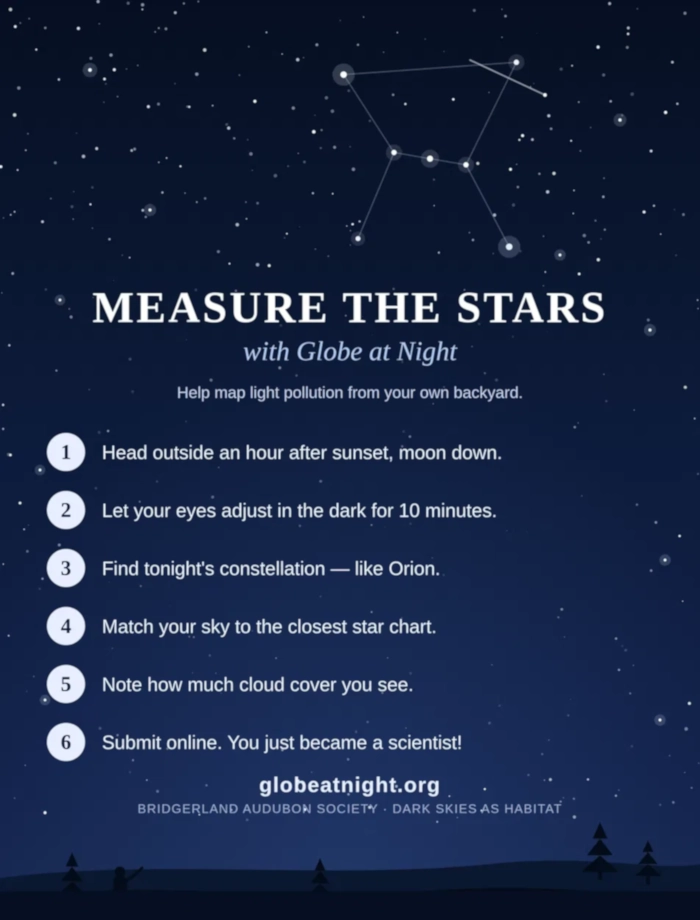
Measure the Stars with Globe at Night
High School Initiatives
Bridgerland Audubon Society
How to use Globe At Night! 🌎✨
- Head out after dark. Go outside more than an hour after sunset, usually between 8 and 10 p.m., and pick a night when the moon isn’t up (a dark, moonless sky gives the most accurate reading!). Get away from direct porch lights or street lights if you can.
- Give yourself about 10 minutes in the dark without looking at any bright screens. You’ll be amazed how many more stars appear once your eyes settle in.
- Find the month’s constellation. Each campaign uses a bright, easy-to-spot constellation, like Orion in the winter months. You can track it down with a printed star-finder chart or a free stargazing app if you have one.
- Match your sky to a chart. Globe at Night gives you a set of simple star charts, each showing that constellation with fewer and fewer stars. Just pick the one that looks most like what you actually see overhead. The faintest stars you can still make out tell the story of how much light is washing out your sky.
- Note the clouds. Take a quick guess at how much of the sky is covered: clear, a quarter, half, or more.
- Submit your report. Enter your observation at globeatnight.org. It takes a minute, and the site can grab your date, time, and location automatically, or you can type them in. You’ve just contributed to a worldwide light-pollution map!
Do it once, or (even better) make it a habit and watch how your sky changes through the seasons. Every observation helps us protect dark skies for birds and wildlife!
Why Dark Skies Matter
A truly dark, starry sky used to be something anyone could step outside and see. Today most of us live under a permanent glow, and that glow is harder on wildlife than it looks. Billions of birds migrate at night, navigating by the stars, and artificial light pulls them off course and into cities where they collide with windows. Fireflies can’t find mates, pollinators circle bulbs instead of flowers, and our own sleep gets thrown off too. A lot of that light is simply wasted, shining up into the sky or sideways where no one needs it.
The good news: light pollution is one of the easiest environmental problems to fix. It disappears the moment you flip a switch, and small changes at home help the birds and wildlife right in your neighborhood!
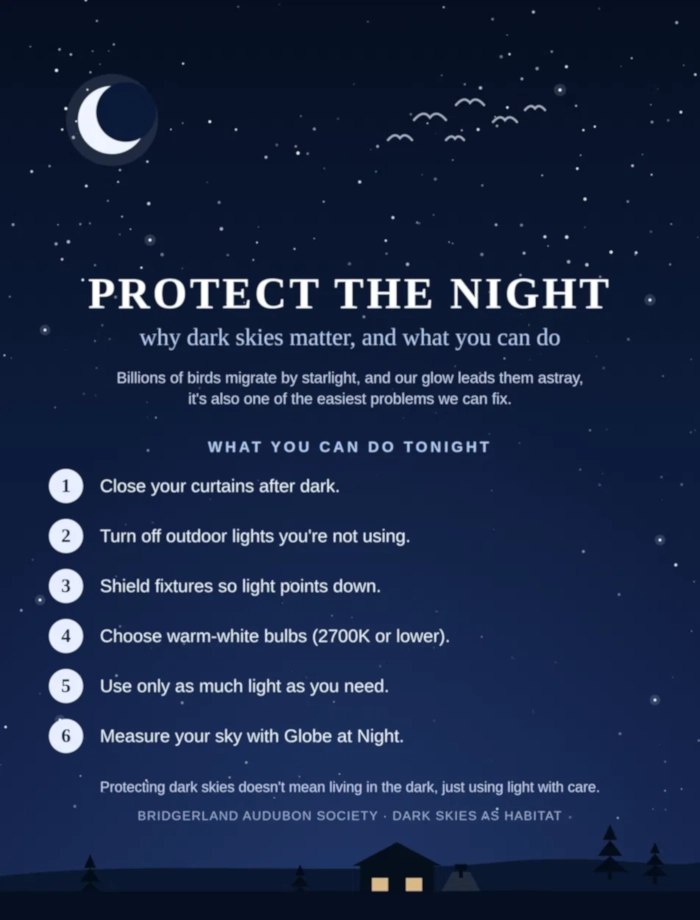
Protect the Night
Logan High School L.E.A.F.
Bridgerland Audubon Society
What You Can Do Tonight
- Close your curtains after dark so indoor light stays inside.
- Turn off outdoor lights you’re not using, or put them on a motion sensor or timer.
- Shield fixtures so light points down at the ground, not up or sideways.
- Choose warm-colored bulbs (warm white, around 2700K or lower), gentler on birds, insects, and your sleep.
- Use only as much light as you actually need.
- Measure your own sky with Globe at Night and help track the problem.
Protecting dark skies doesn’t mean living in the dark, just using light thoughtfully, so people and wildlife can share the night.
Utah Dark Skies:
Utah Dark Sky Parks, Utah Office of Tourism, https://www.visitutah.com/places-to-go/dark-sky-parks
Utah State Parks Starry Nights Initiative, Utah State Parks, Utah Division of Natural Resoures, https://stateparks.utah.gov/activities/dark-sky/
Videos:
Dark Skies and Window Protection play a roll in preventing bird deaths both at night and during the day. View these videos and visit our Protect Birds Against Window Strikes page.(https://bridgerlandaudubon.org/window-strikes/)
1. Cornell Lab of Ornithology, Treat Glass by Day, Dim Lights at Night. Help Prevent Bird Collisions! (1.4 mn), https://youtu.be/oa_ShmzUxy4
2.Birds Connect Seattle, Save Birds from Window Collisions (1.16 mn)
https://youtu.be/4O0P9scA-E8